AIRi Invited Lecture | CERN: Physics, Data and Opportunities for Students
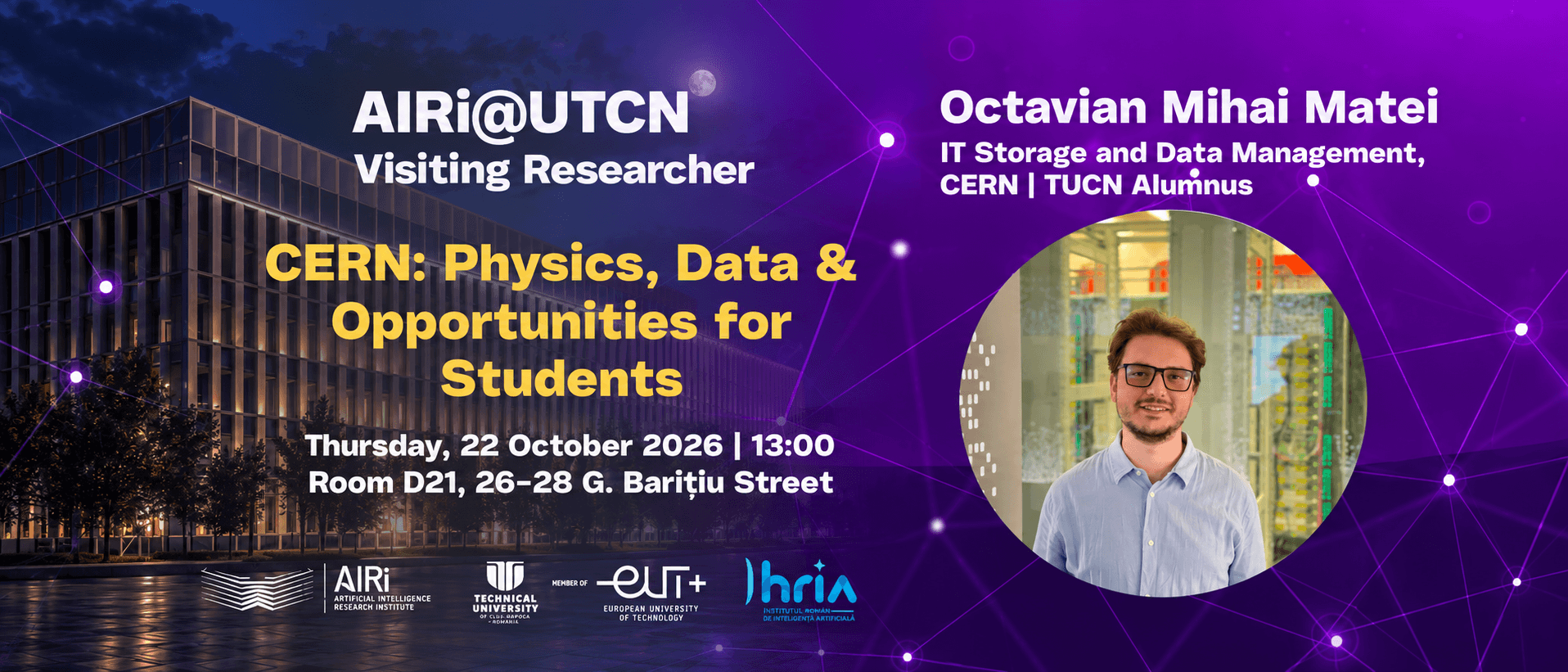
CERN: Physics, Data and Opportunities for Students
AIRi Invited Lecture Series | Octavian-Mihai Matei, CERN
Date: Thursday, 22 October 2026
Time: 13:00
Venue: Room D21, Barițiu Street, Technical University of Cluj-Napoca
Speaker: Octavian-Mihai Matei, CERN IT Department, Storage and Data Management Group
About the Lecture
The Artificial Intelligence Research Institute (AIRi@UTCN) invites students, researchers and members of the academic community to a lecture by Octavian-Mihai Matei, a graduate of the Technical University of Cluj-Napoca (UTCN) currently working in the IT Department at CERN, the European Organization for Nuclear Research.
Located near Geneva, CERN is home to the Large Hadron Collider (LHC), the world's largest particle accelerator. Its 27-kilometre underground ring enables scientists to investigate fundamental questions about the universe. CERN is also where the Higgs boson was discovered and the World Wide Web was invented. Romania has been a CERN Member State since 2016.
The lecture will explore what happens to the vast amounts of data generated by particle collisions at the LHC, following their journey from CERN's detectors to large-scale storage systems.
CERN's experiments generate hundreds of petabytes of data each year, with processing and storage workloads distributed across approximately 170 computing centres in more than 40 countries. Before being distributed, the data is stored at CERN using EOS, an open-source storage system holding more than one exabyte of data on disk. A copy of the LHC data is also preserved on tape.
Drawing on his work in CERN's IT Department, Octavian-Mihai Matei will introduce EOS and discuss its role in supporting major scientific experiments, including ATLAS, the world's largest general-purpose particle detector, and the Alpha Magnetic Spectrometer (AMS), a particle detector operating aboard the International Space Station.
Opportunities for Students
The lecture will conclude with an overview of CERN programmes available to students, including the Technical Student Programme through which Octavian-Mihai Matei began his own experience at CERN.
His professional journey, from studying Computer Engineering at TUCN to working on CERN's large-scale storage infrastructure, offers a valuable example of the opportunities available to students interested in computing and international scientific research.
About the Speaker
Octavian-Mihai Matei works in the Storage and Data Management Group of CERN's IT Department, where he contributes to the development of EOS, CERN's open-source storage system.
He currently serves as service manager for two EOS instances supporting the ATLAS experiment at the Large Hadron Collider and the Alpha Magnetic Spectrometer (AMS) aboard the International Space Station.
A Computer Engineering graduate of UTCN, he first joined CERN as a Technical Student after his third year of university studies. Following graduation, he returned to CERN to join the IT Department's storage team.
Speakers & Participants

Adrian Petru Groza
moderatorProfessor
Adrian Groza is Professor of Artificial Intelligence in the Department of Computer Science at the Technical University of Cluj-Napoca (UTCN) and Vice-Rector for IT Infrastructure and Digitalisation. He has taught at UTCN since 2004 and has supervised doctoral research since 2019. His courses include Artificial Intelligence, Intelligent Systems, and Knowledge-Based Systems. His research brings together knowledge representation, logical reasoning, ontologies, intelligent agents, and explainable AI. He has applied these methods to medical imaging and ophthalmology, including the identification of retinal biomarkers and systems that combine automated analysis with clinical expertise. His work also addresses misinformation, natural language understanding, and the use of AI in education. He is the author of Modelling Puzzles in First-Order Logic (Springer, 2021), a book that uses puzzles to teach formal reasoning. Beyond research and teaching, Professor Groza contributed as a technology expert to Romania’s national strategic framework for artificial intelligence, including work on AI regulation. At AIRi@UTCN, he helps connect research with the computing infrastructure, institutional partnerships, and opportunities for practical application needed to advance the institute’s mission.
Registration & Access Conditions
This event is dedicated to the AIRi@UTCN academic community. Registration is required and available only to participants signed in with a TUCN Microsoft 365 account.
Online Registration Form: https://forms.cloud.microsoft/e/5KDHKWt4i2
Privacy Notice: Photography, audio and video recording may take place during this event. By participating in the event, you acknowledge that photographs and audiovisual recordings in which you may appear may be used by AIRi@UTCN and the Technical University of Cluj-Napoca for communication and dissemination purposes, including news, websites, social media, promotional materials, webcasts and other institutional communications.